Deploying the Practice
On operating among other actors: the householder's problem, and its philosophy.
May 2026 · 19 min read
A person who has cleared their signal, protected their will, and learned to convert perception into action still has to operate in a world where other people are doing none of those things. The four practices of the preceding essays produce a capable agent. They do not tell the agent what to do next.
The gap is not incidental. It reflects a bias in the traditions I have been drawing on. Most classical philosophies of the good life were written for practitioners whose material needs were assumed to be met by circumstance: monks, philosopher-citizens, gentlemen of leisure. What survives most visibly of these traditions is what applies to that reader. What gets underexpressed is what applies to the person who must actually feed a household, choose counterparties, price their work, and negotiate with actors who are optimizing hard and sometimes in bad faith.
That silence is the subject of this essay. And one tradition, unusually, does not participate in it.
The householder is a distinct philosophical subject
Jainism recognized the problem earlier and more explicitly than most traditions, and built a distinct ethical architecture around it. Umāsvāti's Tattvārtha Sūtra, in its seventh chapter, distinguishes between the mahāvratas, the great vows appropriate to the mendicant, and the aṇuvratas, the limited vows appropriate to the householder. Sūtra 7.2 lays out this fivefold distinction directly. Sūtra 7.20 defines the householder as one who observes the minor vows. Sūtra 7.21 specifies further supplementary vows for lay conduct. The same five virtues (non-violence, truthfulness, non-stealing, chastity, non-attachment) are held in both cases, but held differently. The monk holds them absolutely. The householder holds them in a form calibrated to a life that includes property, employment, dependants, and market participation.
This is not a compromise. It is a distinct ethical architecture, with its own extensive literature. The śrāvakācāra tradition includes the Ratnakaraṇḍa Śrāvakācāra, the Upāsakadaśāḥ, Amṛtacandra's Puruṣārthasiddhyupāya, and Hemacandra's twelfth-century Yogaśāstra, all offering systematic treatment of the householder's vows. The point across this literature is worth pausing on. The person with obligations is not the person with fewer virtues. They are a different subject with different constraints, whose ethical work has its own logic.
The historical result was economically consequential. Jain merchant, banking, and trading communities across western India were economically active because of a particular interpretation of the philosophy, not despite it. The fifth aṇuvrata for the householder is parigraha-parimāṇa: limitation of possessions. The tradition developed the associated concept of icchā-parimāṇa, the limitation of desire itself, which the layperson vows to observe. The practice is concrete: the householder sets numerical limits on categories of possession (fields, houses, gold, silver, grain, livestock) and vows not to exceed those limits.
This is stopping, in the most literal sense. Not "hold wealth loosely" but "commit publicly to a ceiling and do not cross it." The tradition understood that internal non-attachment claims are impossible to verify and easy to self-deceive about. External commitments to specific limits are checkable.
The classical formulation is limitation rather than prohibition. A contemporary economic interpretation follows from that distinction, and I want to mark it clearly as mine rather than as the tradition's own. Wealth may remain instrumentally legitimate while its indefinite maximization does not. The stopping point in modern circumstances cannot be a fixed count of cattle or gadyānakas of gold, but the practice of setting bounds and respecting them is the same practice, and it addresses a problem the modern default has no philosophy for.
What the modern default fails to do
Two responses to the operating environment of contemporary commerce present themselves easily. Both fall short of the śrāvaka position.
The first is asceticism disguised as principle. The market is corrupt, the argument runs, and the ethical response is to withdraw: minimize needs, refuse participation, keep the signal clean at the cost of material outcomes. This position sounds principled and often is not. It usually depends on external subsidy: inherited wealth, a supporting partner, or a system of social provision paid for by other people's non-ascetic labour. It usually cannot be sustained by anyone with real obligations to others. A householder who declares detachment from material outcomes is often really declaring that others in the household will bear the cost of that detachment.
The second is what one might call the strategic-adversarial mode. If the game is what it is, the argument runs, the rational response is to become excellent at it on its own terms. Understand the incentive structures, identify the asymmetries, extract value where extraction is available, and treat other actors as variables in the optimization problem. This position also sounds principled: realistic, unsentimental, adult. It produces material outcomes. It has, in my own experience, a particular seductiveness for people who have developed the perceptual capacity the earlier essays describe. Perception makes the strategy available. Effectiveness reinforces it. The reinforcement makes further perception feel like further capability rather than further capture.
I know this configuration from inside it. I stepped back from it some years ago because it took me somewhere I did not want to be, and the somewhere was not primarily a moral place. It was a phenomenological one. I could feel the mode changing what I noticed, what I wanted, and what I found interesting. Aristotle, writing on virtue in the Nicomachean Ethics, diagnosed the mechanism directly: virtues and vices are stable dispositions formed by repeated action. We become just by performing just acts and, by exact symmetry, extractive by performing extractive acts. The character is downstream of the practice, not upstream of it. This is the endogenous cost most contemporary decision theory ignores. The strategic-adversarial mode wins the transaction and loses the actor.
Neither position, the withdrawn ascetic nor the strategic operator, is what the śrāvaka tradition actually recommends. The śrāvaka is capable. The śrāvaka acts. The śrāvaka accumulates within stated bounds and refuses to allow accumulation to become its own justification. And the śrāvaka's practice is public and checkable rather than a private claim about internal disposition.
Capacity, orientation, constraint
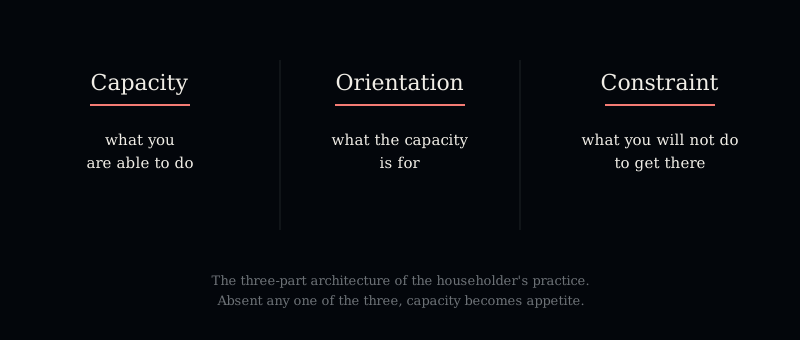
The way out of the false binary is a three-part distinction that the śrāvaka tradition articulates in practice but does not always name explicitly. Any capable agent operates with three separate things: capacity, orientation, and constraint. Capacity is what the agent is able to do. Orientation is what the agent is trying to produce. Constraint is what the agent will not do in order to produce it.
Martial-arts traditions have long articulated the relationship between capacity and constraint more clearly than commercial ones. Non-violence practised by a person incapable of violence is not the same thing as non-violence practised by a person capable of overwhelming force. The first is incapacity. The second is a choice. Restraint is most fully demonstrated when the alternative is genuinely available. Capacity gives constraint its evidential force. The point generalizes cleanly: non-manipulation from a person who cannot read incentive structures is not the same as non-manipulation from a person who reads them perfectly and chooses another mode.
Orientation is the term most often missing from this analysis, and its absence is why the capacity-plus-constraint framing on its own does not fully resolve the problem. A capable agent with self-imposed constraints still needs to decide what to pursue. Bounded goals are necessary but not sufficient. Even a well-executed bounded goal can constitute the pursuer as someone whose achievement is inseparable from what the pursuit required. The mode in which the goal was pursued becomes part of the person who achieved it. A goal reached through modes the pursuer would not endorse leaves the pursuer with an achievement they cannot fully inhabit.
The śrāvaka tradition supplies all three. Capacity is presupposed: the householder is understood to be capable of considerable material action. Orientation is supplied by the vows themselves, which are undertaken in service of specific ends (the household, the community, the lay institutions). Constraint is specified concretely, in the numerical limits of parigraha-parimāṇa and the associated disciplines of icchā-parimāṇa. Nothing is left to internal disposition alone.
The Western traditions have addressed this territory but not integrated it in the same way. Adam Smith's Theory of Moral Sentiments offers the mechanism by which a capable agent constrains conduct: the impartial spectator, the internalized third-person judge whose approval we seek independent of external reward. Max Weber, in The Protestant Ethic and the Spirit of Capitalism, describes what happens historically when a form of disciplined worldly asceticism loses its motivating constraint but retains its productive apparatus: the famous iron cage, capacity retained and orientation evacuated. Neither Smith nor Weber offers what the śrāvaka tradition offers, which is a public, checkable, calibrated practice of bounded lay action. Both describe pieces of the architecture. The śrāvaka tradition builds the architecture.
Provision, not possession
If capacity, orientation, and constraint are the three axes, the practical question becomes what the capable householder should actually be oriented toward.
There is a rough sequence from bare survival upward through which any material trajectory passes: scarcity, sufficiency, security, optionality, status, accumulation, domination. Each stage is a different relationship to material outcomes. Scarcity is want unmet. Sufficiency is want met at the base. Security is sufficiency extended forward in time. Optionality is security plus the resources to change direction if change is warranted. Status is optionality plus a positional claim in the eyes of others. Accumulation is the pursuit of resource for its own sake, unmoored from any specific use. Domination is accumulation deployed to constrain the options of others.
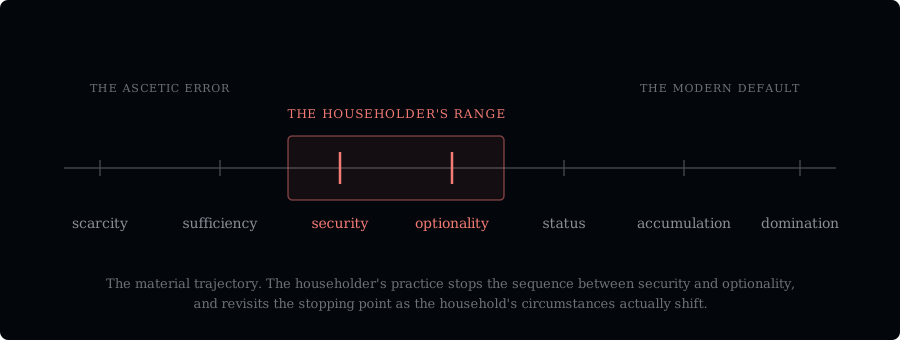
A purely ascetic reading would stop near sufficiency. This is defensible for a monk and destructive for a person with dependants. The modern default reading tells the householder to continue as far as capability permits, generally into accumulation and often into the tacit pursuit of domination. This is also destructive, though the destruction is downstream and internal.
The householder's practice, properly understood, stops the sequence somewhere in the security-to-optionality range. Not lower, because lower is not honest about the actual costs of dependants in an expensive world: children's education, healthcare not covered by whatever public system one happens to live under, housing in cities where the work is, retirement provision for a lengthening old age. And not higher, because higher is where the objective function stops serving anyone identifiable and begins serving itself.
Where exactly the stopping point sits is contextual. It shifts with the ages of children, the geographic base, the health of the household, the state of the market, the specific things the household is trying to protect against. It is not a number. It is a discipline about what the number is for, periodically recalibrated as the household changes. This is the modern form of parigraha-parimāṇa: not a fixed count but a bounded orientation, held publicly and revisited honestly.
The specific difficulty is that the mode of operation which produced past accumulation is the thing hardest to switch off, precisely because it worked. Sunk costs traps the operator in ventures that have failed; sunk benefits traps the operator in ventures that have succeeded, past the point where the success was meant to serve. The mode continues because it has been rewarding, because the systems for producing it are in place, because the identity of the producer has fused with the producing. The householder's discipline is to notice this and to stop, or to shift register, when the purpose that justified the intensity has been met. This is harder than the initial construction of the practice, because it requires giving up something that is still working.
The field of actors
Given a bounded orientation, the operational question is how to engage the actors one encounters.
Counterparties in modern commercial environments fall across a rough spectrum. Some are cooperative, willing to increase mutual surplus, sincere in their dealings. Some are transactional, willing to cooperate where incentives align, uninterested in cooperation where they don't. Some are opportunistic, willing to cooperate while exploitation is unavailable but not committed to cooperation for its own sake. Some are extractive, actively manufacturing information asymmetry and dependency, treating the interaction as a resource to be mined rather than an exchange. And some are simply unreliable: not intending harm but incapable of sustained cooperation. An extractive actor becomes colloquially recognisable as predatory where the behaviour is intentional and repeated.
The taxonomy does not fully capture regulators and other institutional agents whose interest is not in the transaction itself but in the constraints under which transactions may occur. These actors cannot be walked away from, and cannot be routed around without becoming a different kind of actor oneself. Their rules become part of the design of the business rather than friction to be minimised. A compliance function that treats regulation as a design constraint operates in the register this essay is describing. A compliance function that treats regulation as an obstacle operates in the register of extraction.
Kauṭilya's Arthaśāstra is the classical text on operating among unlike actors without moralism. Its concept of the mandala, the field of surrounding states, some naturally allied and some naturally opposed by position rather than by intent, is a map, not a judgment. The lesson generalizes. Treating unlike counterparties alike is itself a perceptual failure, and it is the perceptual failure most often defended in the name of egalitarian goodwill. It is not goodwill. It is the refusal to see. A practical application of ahiṃsā suggests an escalation rule: tolerate where possible; otherwise repel, exclude, or relocate; inflict serious harm only where lesser interventions cannot protect the relevant interest. The Jain tradition took this discrimination seriously. Mendicants have historically observed practices designed specifically to avoid harm to insect and microscopic life (sweeping the ground before stepping, filtering drinking water) while accepting that lay life would require calibrated response to threats the mendicant does not face.
Sales as the working example
Nothing in the above is abstract for anyone actually operating in commercial life. It is most concretely tested in sales.
The default configuration of sales operates on borrowed light in the sense of the first essay in this collection. The seller studies the surface response the buyer's psychology produces to certain stimuli and adjusts the presentation to trigger the response. The buyer's actual want is treated as a variable to work around rather than to engage with. Robert Cialdini's classical inventory of influence, first published in 1984, catalogued the recurrent principles by studying successful compliance professionals. What was descriptive then has since been industrialized, catalogued in the dark patterns literature that Harry Brignull began in 2010 and scholars like Colin Gray have developed since. The Cialdini inventory now describes how consumer software is architected as a default.
Peter Drucker articulated the alternative in Management: Tasks, Responsibilities, Practices, in the formulation that the aim of marketing is to make selling superfluous, because if the product genuinely fits the buyer's need, the transaction reduces to information transfer. Theodore Levitt's earlier Marketing Myopia, published in 1960, made the same argument in complementary language: the seller who defines the business by what it produces rather than by what need it serves will optimize its way into irrelevance.
The Drucker-Levitt configuration is sales as matched fit. The seller understands what they have well enough to know who it is for and, crucially, who it is not for. The seller engages the buyer's actual want rather than the buyer's exploitable surface. If the fit is real, the transaction happens. If it is not, the seller says so and walks.
I want to be careful about what this configuration promises. It does not promise that matched-fit sales financially dominates extractive sales over any specific time horizon. Plenty of extractive businesses compound enormously well for decades. The householder's constraint must remain binding even where violating it would have positive expected financial value, or the philosophy has reduced itself to enlightened self-interest, which is not philosophy at all. What matched-fit sales does produce, reliably, is a set of second-order effects that compound in their own way: retention, referrals, the psychological coherence of the operator who does not have to remember which version of the pitch they used with which customer, and a reputation that eventually becomes an asset in its own right. Whether these effects dominate the extractive alternative financially is contingent on the business. That they exist, and that they matter to the operator regardless of their financial magnitude, is what makes the practice sustainable in the operator's own life.
Matched-fit sales is what the śrāvaka's parigraha-parimāṇa looks like when it meets a modern commercial life. Wealth is pursued, sometimes substantially. The capacity to extract is retained. The orientation is toward fit. The constraint is on the deployment.
What the practice becomes
The four practices of the earlier essays make you effective. This essay has proposed that the missing element is not a fifth technique but a three-part architecture the four practices operate within: capacity in what you can do, orientation in what the capacity is for, constraint on what you will not do to get there. The śrāvaka tradition supplies the fullest working example of that architecture, and its adaptation to modern conditions is available to anyone willing to hold the practice in its full form rather than in its more comfortable half-versions.
There is a reason the practice is uncommon, and it is not that the practice is philosophically difficult. It is that most operators reason in first order. They see the transaction, the deal, the quarter, the outcome. The second order — what the transaction is doing to them, to the counterparty, to the field they operate in, to the character they are forming through repetition — is invisible or dismissed as soft. The householder's practice requires attention to second-order effects that most operators have never developed, because the systems they built their careers inside were sufficiently stable that first-order reasoning was enough.
This is about to become more valuable rather than less. The current transition to systems in which agents operate on behalf of principals, with permissions and trust boundaries and consequential actions taken at machine speed, is a second-order transition. Its effects will not be visible in any single transaction. They will emerge from the interactions, and they will be behavioural as much as technical. The people equipped to reason about them are the people who have already been reasoning that way about the ordinary conduct of business. The householder's practice, developed for reasons that had nothing to do with technology, turns out to have prepared its practitioners for exactly the environment now taking shape.
The prior essays established: clear the perception, preserve the agent, act into reality. This essay adds: choose an end, discriminate among actors, deploy proportionately, stop when the end has been served, and stay awake to what the practice is doing to the practitioner. That last is the whole work.
═══════════════════════════════════════════════
Notes & References
Umāsvāti, Tattvārtha Sūtra (c. 2nd–5th century CE), chapter 7, on the vratas, with sūtra 7.2 laying out the fivefold mahāvrata/aṇuvrata distinction, 7.20 defining the householder through observance of the minor vows, and 7.21 specifying further supplementary lay vows. English edition: Nathmal Tatia, trans., That Which Is: Tattvārtha Sūtra (San Francisco: HarperCollins / Institute of Jainology, 1994).
The śrāvakācāra tradition includes the Ratnakaraṇḍa Śrāvakācāra attributed to Samantabhadra (c. 2nd century CE), the Upāsakadaśāḥ (7th aṅga of the Śvetāmbara canon), Amṛtacandra's Puruṣārthasiddhyupāya (c. 10th century), and Hemacandra's Yogaśāstra (12th century), each offering systematic treatment of lay vows. English edition of the Yogaśāstra used: Olle Qvarnström, trans., The Yogaśāstra of Hemacandra: A Twelfth Century Handbook on Śvetāmbara Jainism, Harvard Oriental Series 60 (Cambridge, MA: Harvard University Press, 2002).
Padmanabh S. Jaini, The Jaina Path of Purification (Berkeley: University of California Press, 1979), the standard modern academic reference on Jain doctrine and the śrāvaka.
John E. Cort, Jains in the World: Religious Values and Ideology in India (New York: Oxford University Press, 2001), on how Jain philosophy has been practised in commercial and communal life.
Christopher Key Chapple, ed., Jainism and Ecology: Nonviolence in the Web of Life (Cambridge, MA: Harvard University Press for the Center for the Study of World Religions, 2002), for contemporary applied treatments of aparigraha.
Kauṭilya, Arthaśāstra, Books 6–7 on the mandala. English edition: Patrick Olivelle, trans., King, Governance, and Law in Ancient India: Kauṭilya's Arthaśāstra (New York: Oxford University Press, 2013).
Aristotle, Nicomachean Ethics, Book II (1103a–1105b), on virtue as hexis. English edition: Terence Irwin, trans., Nicomachean Ethics, 2nd ed. (Indianapolis: Hackett, 1999).
Adam Smith, The Theory of Moral Sentiments (1759), on the impartial spectator. Standard modern edition: D. D. Raphael and A. L. Macfie, eds., The Theory of Moral Sentiments, Glasgow Edition of the Works and Correspondence of Adam Smith, vol. I (Oxford: Clarendon Press, 1976; repr. Indianapolis: Liberty Fund, 1982).
Max Weber, Die protestantische Ethik und der Geist des Kapitalismus, first published in Archiv für Sozialwissenschaft und Sozialpolitik vols. XX–XXI (1904–05), revised 1920. English: Talcott Parsons trans., The Protestant Ethic and the Spirit of Capitalism (London: George Allen & Unwin; New York: Charles Scribner's Sons, 1930). The empirical historical claim remains contested; the essay draws on Weber for the phenomenology of the iron cage rather than as evidence for a causal thesis about Protestantism and capital accumulation.
Peter F. Drucker, Management: Tasks, Responsibilities, Practices (New York: Harper & Row, 1973), for the formulation on marketing making selling superfluous.
Theodore Levitt, "Marketing Myopia," Harvard Business Review 38, no. 4 (July–August 1960): 45–56.
Robert B. Cialdini, Influence: The Psychology of Persuasion (New York: William Morrow, 1984; expanded ed. New York: Harper Business, 2021), derived from Cialdini's research on successful compliance professionals across sales, advertising, fundraising, negotiation, and other fields.
Harry Brignull, darkpatterns.org (2010; now deceptive.design). See also Colin M. Gray, Yubo Kou, Bryan Battles, Joseph Hoggatt, and Austin L. Toombs, "The Dark (Patterns) Side of UX Design," in Proceedings of the 2018 CHI Conference on Human Factors in Computing Systems (New York: Association for Computing Machinery, 2018), 1–14, https://doi.org/10.1145/3173574.3174108.
Enjoyed this? Get notified when I publish something new.